

How To Create A System Backup In Windows 10
How to brand a Windows 10 or eleven prototype backup
Making a full system epitome backup preserves not only your files, simply Windows and all its settings besides. Here are the best free Windows backup and recovery tools with step-by-step instructions.

- What is an paradigm backup, anyway?
- How epitome backup works
- Don't utilise the built-in Windows backup utility
- Back upwards and restore Windows with tertiary-political party fill-in tools
Prove More
When things go incorrect with Windows, as they sometimes volition, nothing ensures a faster or easier return to normal than restoring a contempo image fill-in.
To that end, I back up my production PCs at 9 a.m. every day. That means that I'll never lose more than a solar day's work if something should go desperately plenty incorrect to forcefulness that day's prototype backup to be restored.
In the sections that follow, I explain what all this means, how it works, and why you shouldn't use congenital-in backup in either Windows 10 or eleven. Finally, I'll walk you lot through how to apply my favorite costless prototype backup tool while recommending a couple of other acceptable alternatives.
What is an image backup, anyway?
Simply put, an prototype backup is a snapshot of the complete contents of all partitions on a figurer'southward C: bulldoze. In other words, it's an exact copy ("image") of the drive — operating organisation, information files, settings, and all — not just the files stored on it. Image backups are sometimes chosen system paradigm backups, whole-system backups, full system backups, or other variations on that theme.
If you expect at the disk layout for a typical C: drive, you'll see that it usually includes four or more than partitions, every bit shown in Figure 1.
 IDG
IDG Figure 1: The default Windows 10 and eleven deejay layout comprises 4 partitions: (1) EFI, (ii) MSR, (three) Windows OS, and (4) Windows Recovery Environment (WinRE). (Click image to overstate information technology.)
(Please notation: I utilize the excellent, no-cost MiniTool Partition Wizard Free instead of Windows' born Disk Management tool because Partition Sorcerer shows the Microsoft Reserved, or MSR, partitioning forth with other partitions on the C: bulldoze; in Figure ane information technology occupies 16MB in position 2.)
When y'all make an paradigm backup, all the bits and bytes for each partition are captured. And when an prototype backup is restored, the previous contents of the bulldoze are overwritten, as the image for each sectionalization is written to the target bulldoze afresh and anew.
How image backup works
Making an paradigm backup involves making a snapshot of the contents of each partition on one drive and storing those contents within an paradigm copy for each partitioning on another drive. TechTerms.com describes a disk paradigm as "a software copy of a physical disk" that "saves the unabridged data from the disk, including the file structure and folders from the disk, in a single file."
Thus, each partition is captured in its own image file. Given the correct software, in fact (I'll bear witness a demonstration afterwards on in this story), you can explore an epitome just as if information technology were a standalone file arrangement.
To create an paradigm, special software is used to build the single file (or drove of files) that stand for the whole deejay or its constituent partitions. Disk epitome files are often stored using special binary formats. Thus, for case, the .ISO prototype format (a CD- or DVD-oriented disk paradigm format based on the ISO-9660 standard, which Microsoft uses to distribute images of the Windows installation environment) contains an verbal duplicate of a deejay paradigm, including information saved in files on that disk, as well as file system information and related metadata.
Don't use the built-in Windows backup utility
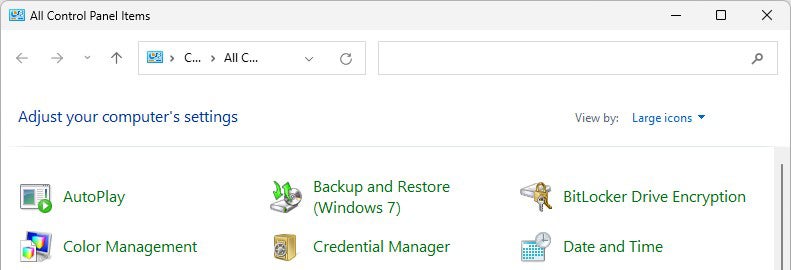
In Windows 7, Microsoft built a Backup and Restore utility into the OS. It's still present in Windows 10 and xi (shown in Figure 2 at the top of the Control Panel window), just information technology's currently called "Backup and Restore (Windows seven)," which provides an of import clue about its status.
 IDG
IDG Figure two: While the Backup and Restore (Windows seven) utility is notwithstanding around, there are much better options.
Microsoft has clearly backed abroad from the tool. The visitor's current "Backup and Restore in Windows" support article mentions the Backup and Restore (Windows 7) utility merely in the context of restoring from system prototype backups created "in previous versions of Windows."
Having followed ongoing fill-in and restore discussions on Windows Ten Forums since October 2014, and on Windows Eleven Forum since June 2021, I can say that none of the participants speak in favor of using the tool any longer. In fact, most Windows gurus recommend using something else because of occasional (but credible) reports of problems when restoring images fabricated using the Backup and Restore (Windows 7) tool. Fortunately, at that place are better options available.
Support and restore Windows with third-party fill-in tools
There are at least three workable, respectable, and highly regarded costless Windows backup tools that work with both Windows 10 and Windows 11:
- Macrium Software's Macrium Reflect Free
- AEOMEI Backupper Standard (Freeware version)
- MiniTool ShadowMaker Complimentary
All three tools make compact, speedy, and reliable image backups of Windows 10 and Windows xi PCs. I have been a devoted user of Macrium Reflect Free for a decade now, and present its apply on Windows 11 in the post-obit screenshots as an analogy of how such programs piece of work. (Your mileage may vary, depending on which tool you choose.)
Create (and schedule) image backups
Macrium provides a left-column menu entry under the "Create backups" tab that reads "Create an image of the sectionalization(south) required to backup and restore Windows." Though there are many other options and capabilities in the program, this is exactly what'south needed here, so I'll step you through working with this facility.
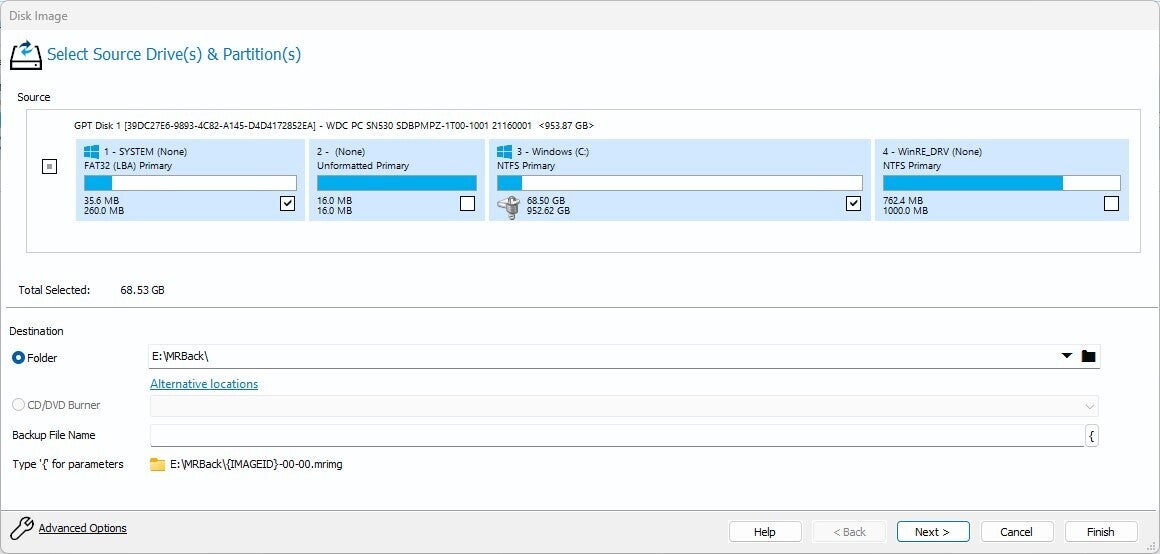
Upon clicking the entry, a map of the Windows (C:) drive appears with two of the four partitions checked, every bit shown in Figure iii. I recommend checking all four partitions before proceeding.
 IDG
IDG Effigy three: Past default, but the EFI (#i) and Windows (#3) partitions are checked. I recommend checking all iv. (Click epitome to overstate it.)
The Destination folder shows where backups volition reside. On my Windows 11 test machine, that'southward E:\MRBack\. The first time you use this programme, you must target some bulldoze different from C: and specify a "home directory" for your backups. The best target for backups, in fact, is an external drive (usually USB); if a system goes actually south, you can use the external drive to restore things to a different PC more easily. Click Next > (at lower correct) to motility to the adjacent screen.
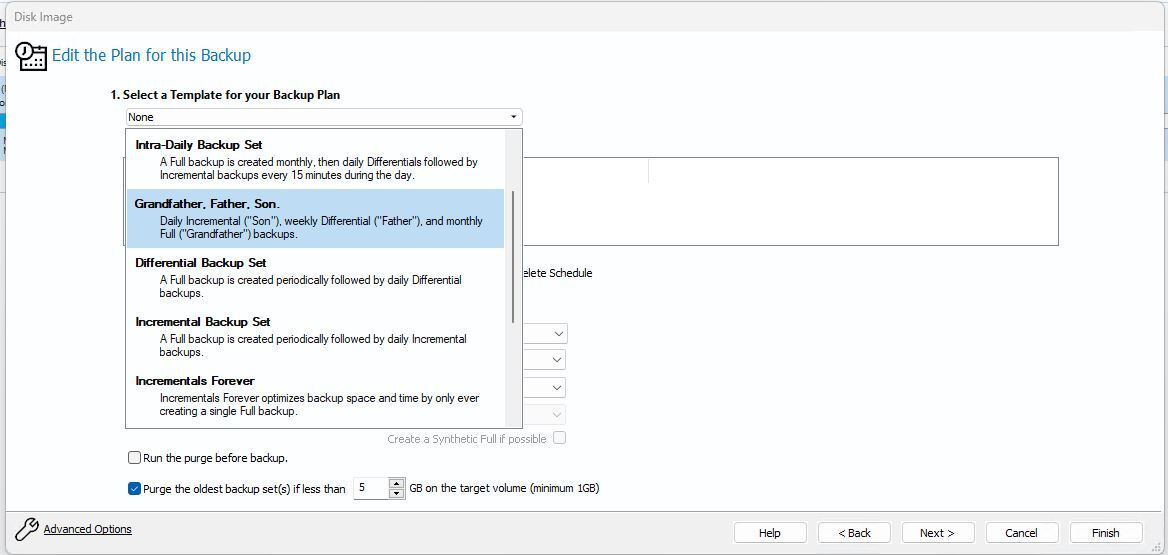
This calls up the "Backup Plan" window, wherein y'all tin specify some kind of backup plan (called a "Template" in the program), as shown in the choices visible in the pull-down carte in Effigy 4.
 IDG
IDG Figure 4: Macrium Reverberate offers a well-documented collection of six different backup plans. (Click image to enlarge information technology.)
The virtually inclusive backup plan is shown at the top of the list and features a full backup each month, plus daily differential backups (everything changed since the previous day) and incremental backups (annihilation new or changing) every 15 minutes all the time. This offers the best overall protection merely requires at least 100-200GB of disk space (more is better) for best results.
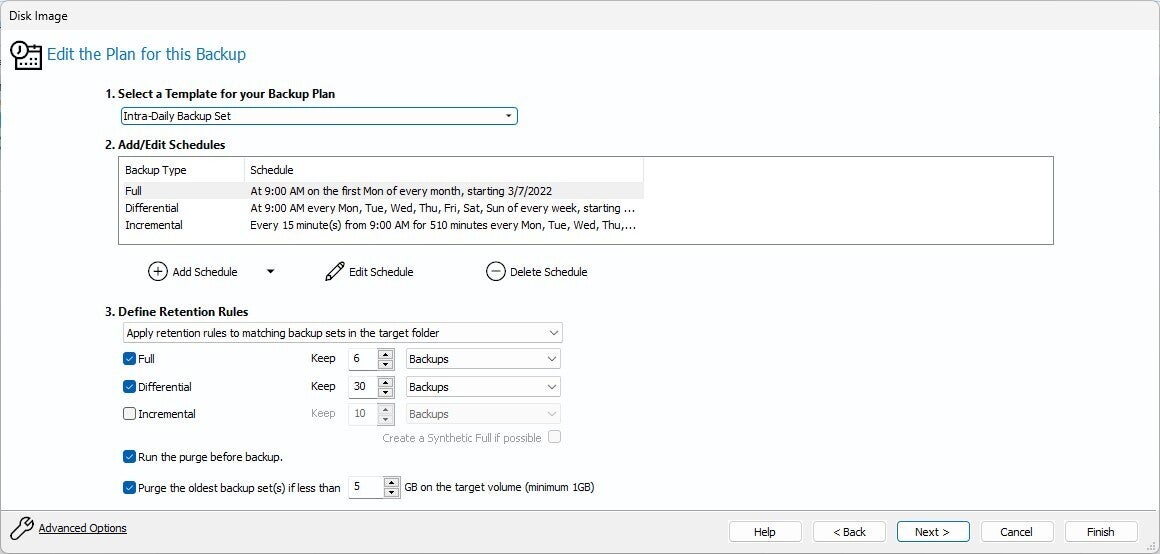
Figure 5 shows plan settings should you pick the Intra-Daily Backup Prepare as your programme, recommended for those looking to obtain maximum information protection, with a large (and relatively empty) drive on which to back up. Macrium Reflect lets you edit the default backup schedule and number of backups saved for the program. (Note: my fill-in drive on this PC offers a nominal 5TB capacity that File Explorer reports as 4.54 TB actual capacity.)
 IDG
IDG Figure five: The Intra-Daily Fill-in Set up properly describes incremental backups as "Stealth," because they're missing from the retention rules (also many to track and log, in fact). (Click image to enlarge it.)
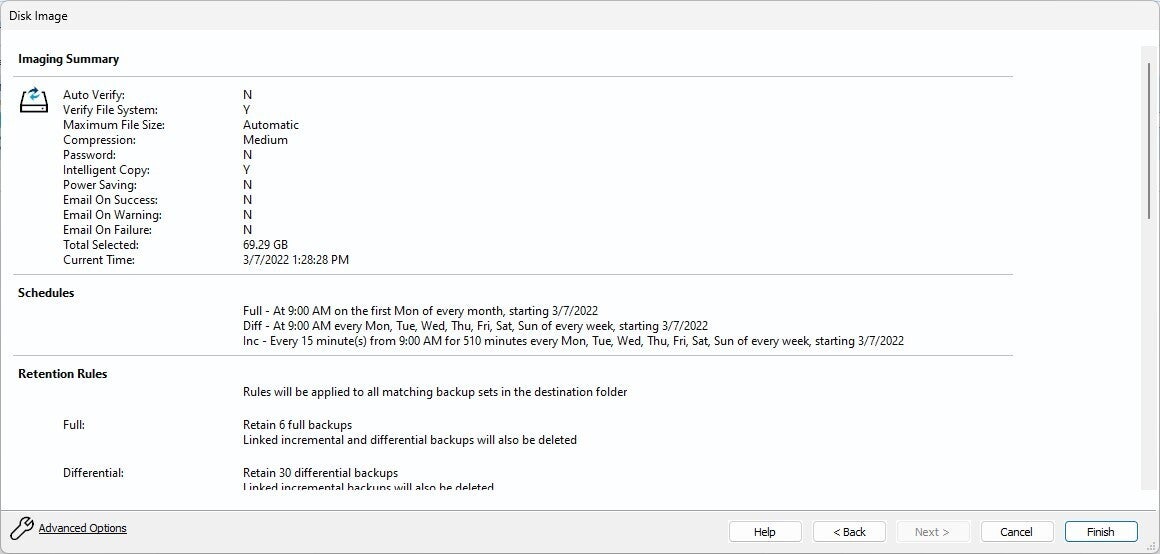
When yous click Next > at the lesser of the Backup Programme window, Reverberate presents a disk image screen that shows you the options you've selected (see Figure six). Notice that the "Total Selected" size for each epitome is 69.29 GB; because the plan uses sophisticated and capable compression, each resulting full backup snapshot is actually 35GB in size. (Differential and incremental backups seldom amount to 10% of that number, though this will vary based on file activity and changes.)
 IDG
IDG Figure 6: The "Disk Prototype" pane stores the details that describe the fill-in's schedule and types. (Click image to enlarge it.)
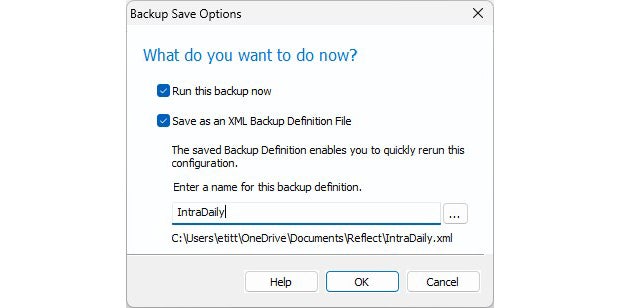
Click Stop to consummate the fill-in description procedure. Then you'll be presented with a pane that provides options to "Run this backup at present" and "Save as an XML Backup Definition File" what you've just divers. (Both options are selected by default, as shown in Figure 7.) To fire off your first such backup, click OK.
 IDG
IDG Figure 7: I named this XML file "IntraDaily.xml" and left the boxes checked. You could practise likewise.
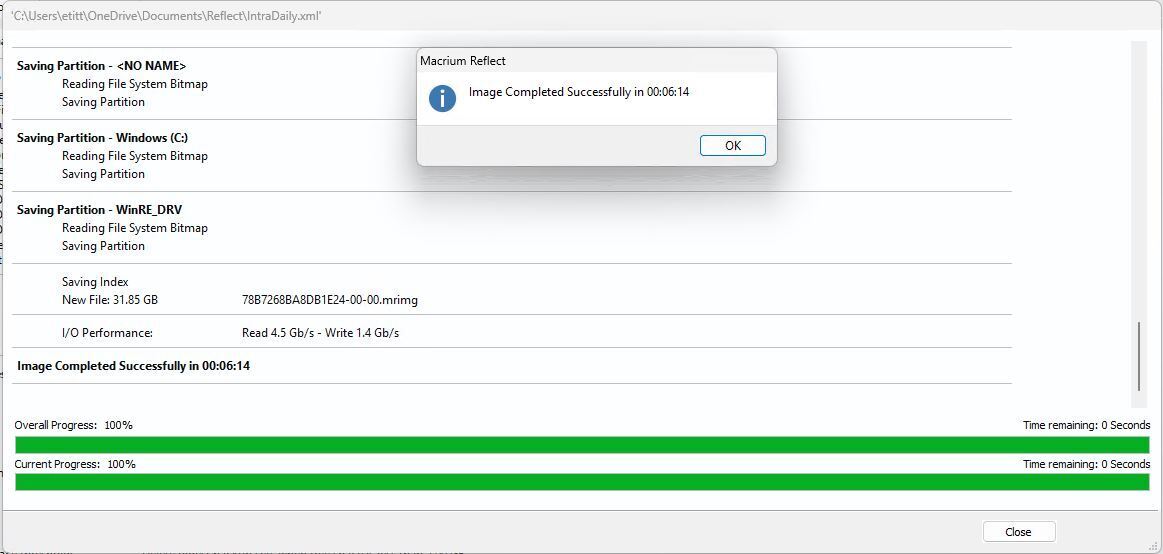
In one case the OK push button is clicked, the first full backup runs. On my test organisation, that took about 6 minutes in all. Notation farther that the on-disk size of the backup is 31.85GB (more than than 50% compression). Figure 8 shows the results from the first total backup run.
 IDG
IDG Effigy 8: Start full backup results took 6:fourteen and consumed 31.85GB deejay infinite. (Click epitome to enlarge it.)
One of my reasons for sticking with Reverberate is its speed: to the best of my cognition neither of the other ii programs I mentioned earlier is quite every bit fast. Considering it runs in the background on reasonably fast PCs, I inappreciably ever notice it'due south working, which is only what you want in a backup plan.
Restore an epitome backup
Should y'all ever demand to restore an image fill-in, it's an easy thing to do. Typical reasons range from the sublime (such every bit OS corruption, driver failures, boot manager problems, malware attacks) to the ridiculous (accidentally deleted key OS files to make a system unusable).
Though Macrium Reflect (and the other programs cited earlier) offer plan menu-based restore functions that are easy to utilize, when a restore is needed, I often discover myself turning to the programme'due south Rescue Media. It is bootable, and smart enough to allow you point to the backup epitome you lot wish to restore rapidly and hands. For me, that normally means the most recent backup before things started going due south.
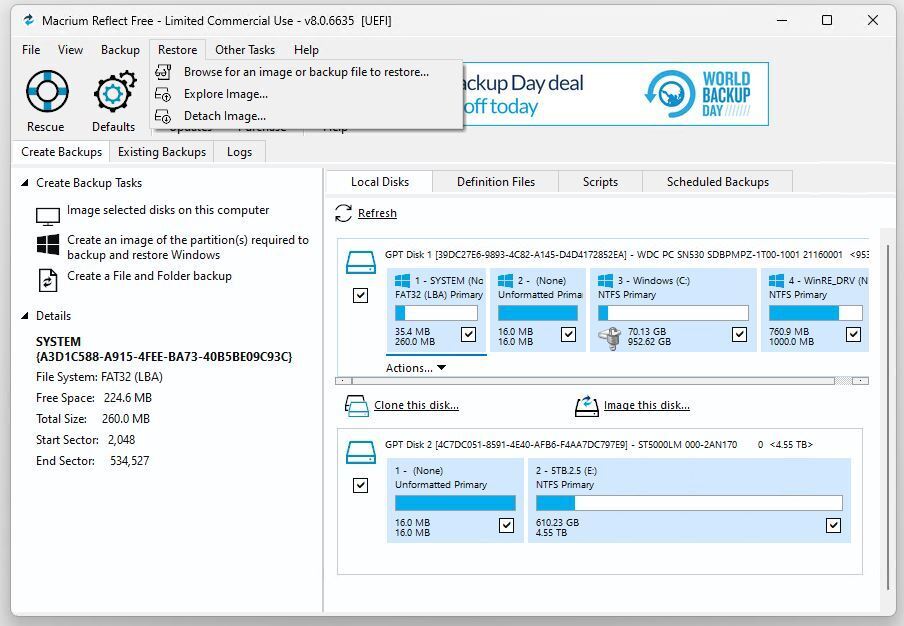
The built-in Restore menu works almost exactly like the restore office bachelor from Reflect's Rescue Media kicking-up. A popular-upwards carte du jour item that appears when you lot click Restore in the program card reads "Scan for an image or backup file to restore," as shown in Effigy 9. That's the one you want.
 IDG
IDG Effigy 9: Click the meridian menu item shown to browse a listing of available backups. (Click image to enlarge it.)
It is important to know the bulldoze letter for your image backups and the name of the folder where they're stored. On my test PC, I know that'southward Drive E: in the MRBack (short for Macrium Reverberate Backup) folder, where such backups take an .mrimg (Macrium Reverberate epitome file) extension. At that place the latest backup is easily identified by its timestamp, as shown in Figure 10. THAT's the one I would desire to restore.
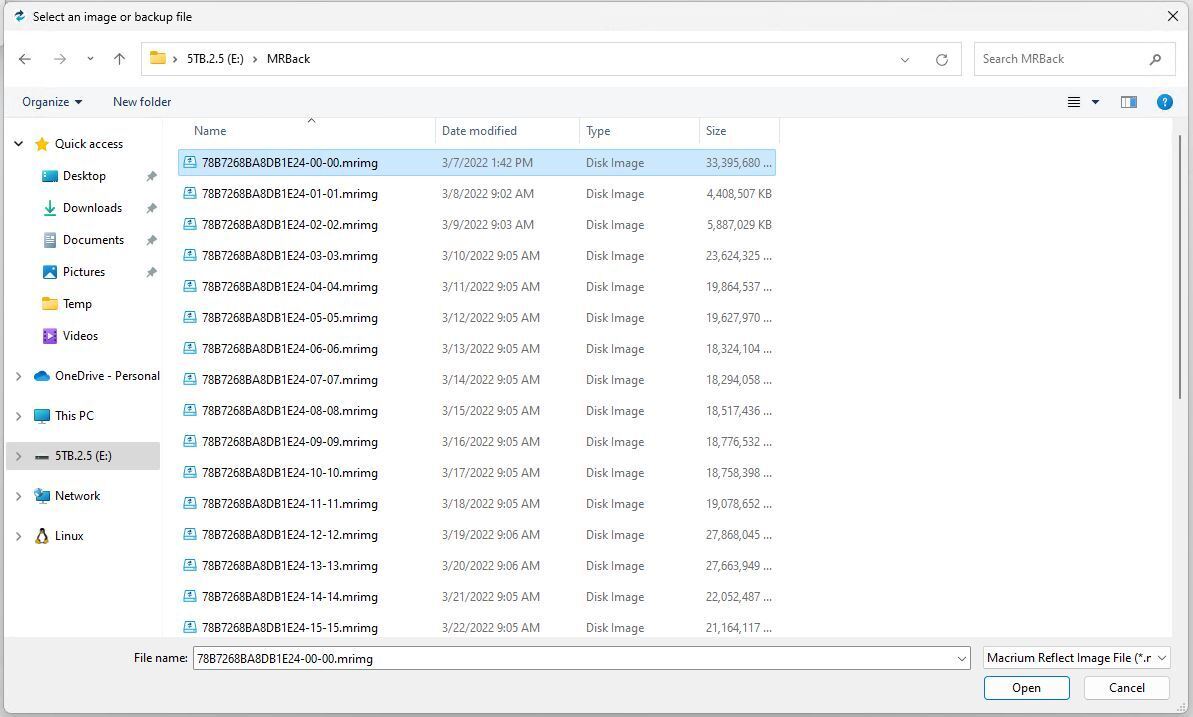 IDG
IDG Figure 10: Select the fill-in y'all desire, and then click the Open push button at lower right to kickoff the restore process. (Click image to enlarge it.)
Only click the Open push to get that process underway: Macrium Reflect does the rest.
Macrium Reverberate (and the other programs) also offer file- or folder-based restore capabilities. To apply them, you'd click the "Explore prototype" item shown in the number 2 position in Effigy 9. This opens a File Explorer-like interface that lets you lot designate which paradigm you wish to explore, then select files and/or folders within that paradigm to restore to the current running Windows image. It's just similar copying files and folders, which I assume readers tin can handle without footstep-by-step instructions, then I'll skip those details here. For the incurably curious, see the MR knowledge base article "Restoring a file and folder backup" for more information.
Pick your fill-in, and use it to the max!
My own option is Macrium Reflect. You can choice any of the options I've presented here equally you see fit. For speed'southward sake, you may desire to consider targeting a fast drive (ideally an NVMe PCIe-x4 SSD) on which your fill-in images volition reside.
But the important matter is to dorsum up regularly and often. That's your best guarantee to minimize data loss if and when the time e'er comes to restore a fill-in. Better to not need it and still take a fill-in than to need one and have none.
Read this next: For more Windows repair techniques, see "How to repair Windows x and xi in 4 steps."
Copyright © 2022 IDG Communications, Inc.
Source: https://www.computerworld.com/article/3655693/how-to-make-image-backup-windows-10-windows-11.html
Posted by: harrellforrie.blogspot.com
0 Response to "How To Create A System Backup In Windows 10"
Post a Comment